




Truck Side Curtain Tarpaulin Guide: Specifications, Selection, Installation & Maintenance
Introduction: The Curtain Is More Than a Cover
The side curtain is the most visible part of a curtainsider — and one of the most abused. It must survive rain, UV, wind flutter at 90 km/h, fork-lift scrapes, and repeated tensioning cycles, all while keeping cargo dry and secure. Choosing the right tarpaulin specification and maintaining the hardware around it directly determines how long a curtain lasts and how much downtime it causes.
1. Tarpaulin Specifications: How to Read Them
A truck side curtain tarpaulin is not a single material — it is a three-layer composite: a woven grid of high-tenacity polyester yarn (warp and weft), PVC coating applied to both faces (by coating or lamination), and surface treatment with UV stabilizers and anti-aging agents.
1.1 GSM (grams per square metre)
GSM is the total weight of the finished fabric per square metre — the single most important number when comparing tarpaulins. It reflects both the density of the polyester base and the thickness of the PVC coating.
| GSM Range | Typical Use | Characteristics |
| 580-680 | Light regional transport, curtain covers | Flexible, lighter, lower cost |
| 650-750 | Mixed regional / national distribution | Good balance of weight and strength |
| 900 (industry standard) | Mainstream European long-haul curtainsider | Best all-round: strength, tear resistance, service life |
| 1000-1100 | Heavy duty: construction, mining, high-abuse | Maximum durability, stiffer, heavier |
Higher GSM means better durability but lower flexibility and more weight per curtain. 900 gsm is the European benchmark for mixed long-haul operations.
1.2 Denier (D) of the polyester yarn
Denier measures yarn thickness. Common values: 1000D x 1000D (warp x weft). Higher denier means thicker yarn and higher tensile and tear strength.
- 500D: light covers only — not suitable for side curtains
- 1000D: standard for commercial truck side curtains
- 2000D: heavy-duty construction and mining curtains
1.3 Weave density and construction
Threads per cm in warp (lengthwise) and weft (crosswise) directions. Typical side curtain construction: 30 x 30 threads per cm with 1000D yarn. Higher thread count increases tensile strength and dimensional stability.
1.4 Coating type: coated vs laminated
| Process | Characteristics | Best For |
| Coated | PVC applied directly to fabric; higher adhesion, better edge sealing | Heavy-duty, high-abuse |
| Laminated | PVC film fused to fabric; smoother finish, better flexibility | Printed curtains, European standard |
Key specs to request from a supplier: GSM, denier (warp/weft), thread count, tensile strength (N/5cm), tear resistance, adhesion strength, UV resistance, temperature range (typically -30C to +70C), flame retardancy if required.
2. How to Choose the Right Tarpaulin
Step 1: Match GSM to your operation
- Regional palletized freight, low abuse: 650-750
- Mixed long-haul, general cargo (default choice): 900
- Construction materials, mining, waste: 1000-1100
- Double-deck operation (weight sensitive): 750-900
Step 2: Choose denier and weave
For any commercial curtain: choose 1000D x 1000D minimum. If your trailers operate in high-wind regions or high-abuse environments, specify 2000D warp.
Step 3: Decide coating and finish
- Standard operation: coated PVC (higher adhesion)
- Printed branding / European fleets: laminated PVC (smooth print surface)
- High UV exposure (Middle East, Africa, Australia): specify UV-stabilized coating
Step 4: Confirm dimensions and fabrication
Provide the trailer body dimensions: curtain height, length, hem allowances, roller spacing, and strap positions. Professional suppliers fabricate with reinforced hem edges, pre-sewn strap attachment points at specified spacing, printed logos, and curtain hooks for roller attachment.
Step 5: Verify supplier quality
Ask for a physical sample, test certificates, and reference fleets. A 900 gsm curtain that fails after 12 months costs more than a quality one that lasts 3-5 years.
3. Installation: Step-by-Step (Curtain to Frame)
Tools needed: ratchet wrench / socket set, roller attachment bolts, dry PTFE spray lubricant, tensioning tool.
- Prepare the frame — clean the top and bottom rail channels; remove debris and old roller fragments; lubricate with dry PTFE spray.
- Attach rollers to the curtain top hem — position at 400-500 mm spacing, bolt each roller bracket to the top hem reinforcement, check free wheel rotation.
- Hang the curtain into the top rail — feed rollers into the top rail channel from one end; slide full length to confirm free travel.
- Hook the bottom straps — pull curtain closed; hook each 2 inch polyester bottom strap under the bottom rail; seat every hook fully.
- Tighten the over-center buckles — work from one end, apply even tension; over-tightening distorts the hem, under-tightening causes sag.
- Fit the tensioners (fore/aft) — install ratchet tensioners at front and rear curtain ends; tension evenly to remove wrinkles.
- Test and re-tension — open and close 3-5 times; after the first loaded trip, re-tension all straps and buckles.
4. Locking Hardware: What the Curtain Depends On
| Component | Function | Key Specs |
| Curtain rollers | Allow the curtain to slide along the top rail | Sealed ball bearing, 30-33.5 mm wheel dia |
| Top rail (aluminum profile) | Carries the rollers | 6063-T5 aluminum, 1.0-2.5 mm wall |
| Bottom rail | Guides the hem, receives strap hooks | C-channel aluminum profile |
| Polyester bottom straps | Connect curtain to bottom rail | 2 inch (50 mm) wide, closed wire/flat hook |
| Over-center buckles | Apply and hold bottom tension | Galvanized or stainless steel, ~1 per metre |
| Ratchet tensioners | Fore/aft curtain tension | Square 12x12, galvanized steel |
| Sealing gaskets | Weather seal at front/rear | EPDM rubber |
| Pelmet sections | Reinforce and protect curtain top edge | Aluminum profile |
Hardware quality notes: sealed ball bearing rollers need no lubrication and last 2-4 years; plain bushing rollers fail in 6-18 months. Galvanized steel buckles for standard use, 304 stainless steel for reefer or chemical environments. Inspect straps for fraying at hook points — the most common failure point.
5. Maintenance & Care
Daily (pre-trip)
- Walk around the curtain: check for new cuts, loose straps, or displaced hooks
- Verify all over-center buckles are closed and holding tension
- Confirm the curtain slides freely
Monthly
- Inspect fabric for seam fatigue, UV embrittlement, and abrasion at hem edges
- Check bottom straps for fraying at the hook
- Lubricate rail channels with dry PTFE spray (sealed bearings need none)
Quarterly
- Re-tension all straps, buckles and tensioners
- Inspect rollers: replace flattened or cracked wheels before they damage the rail
- Check rail channels for dents and debris
Annual
- Full curtain inspection: replace if fabric is embrittled or heavily patched
- Replace worn rollers (2-4 year typical life)
- Check sealing gaskets at front/rear; replace cracked EPDM
- Inspect rivets and bolts on all hardware
Small repairs
- Cuts under 50 mm: PVC repair glue or heat-weld patch
- Larger damage: professional patching or section replacement
- Never drive with a torn curtain — wind flutter will enlarge the damage rapidly
6. FAQ
What GSM curtain should I buy?
900 gsm PVC-coated polyester is the European standard for mixed long-haul. Use 650-750 gsm for light regional work to save weight, and 1000+ gsm for construction, mining or high-abuse operations.
What does 1000D mean?
Denier measures polyester yarn thickness. 1000D x 1000D (warp x weft) is the minimum recommended for commercial side curtains — it provides the tensile and tear strength the curtain needs.
Coated or laminated PVC — which is better?
Coated PVC has higher adhesion and better edge sealing (better for heavy duty). Laminated PVC has a smoother finish and better flexibility (preferred for printed curtains). Both work at 900 gsm.
How often should curtain rollers be replaced?
Sealed ball bearing rollers typically last 2-4 years. Replace them as soon as travel becomes stiff or wheels show flat spots — worn rollers damage the rail channel.
How long does a truck side curtain last?
With proper maintenance, a quality 900 gsm curtain typically lasts 3-5 years in mixed long-haul service. Roof curtains last 5-8 years.
How do I prevent curtain flutter at highway speed?
Ensure over-center buckles are correctly adjusted and ratchet tensioners are tight. Replace worn buckles and stretched straps. Proper tension prevents sag and flutter.
Can my curtain be printed with our logo?
Yes. PVC-coated polyester accepts direct printing — many fleets print branding and safety markings. Provide artwork to your supplier and they will cut, print and fabricate to size.
7. Ganland: Tarpaulin & Curtain Hardware Manufacturer
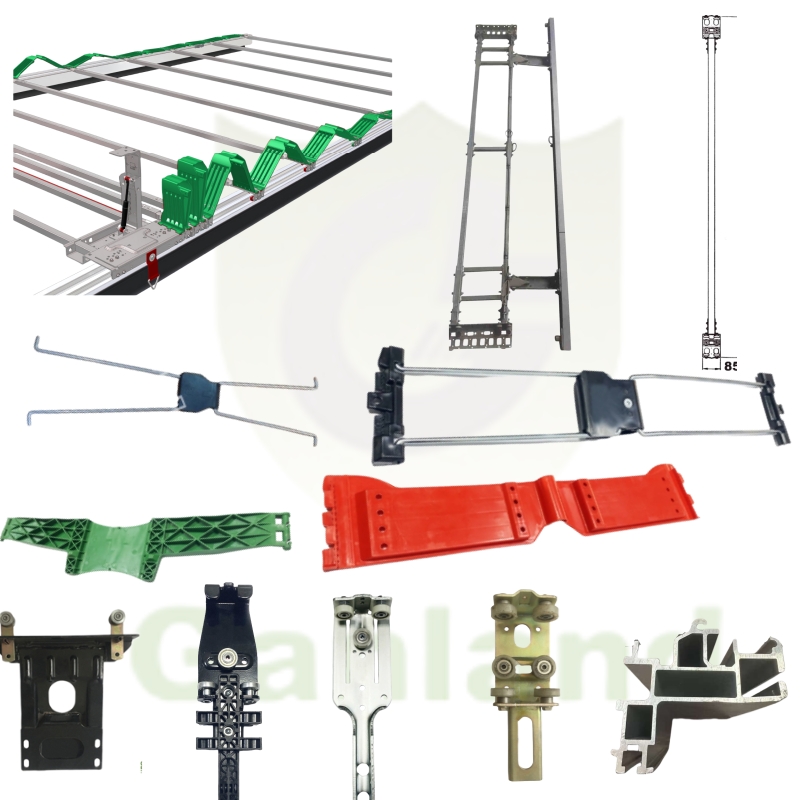
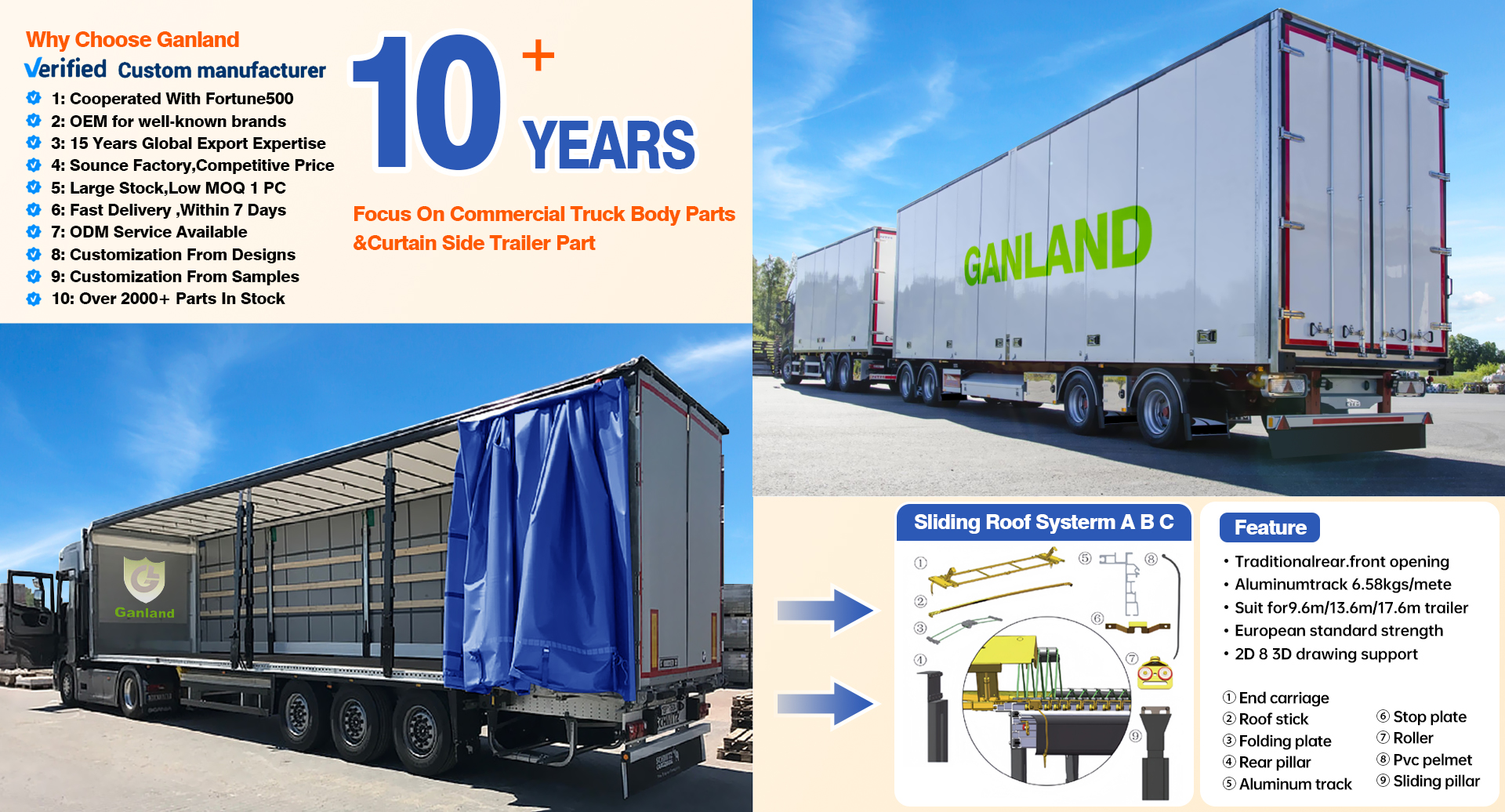
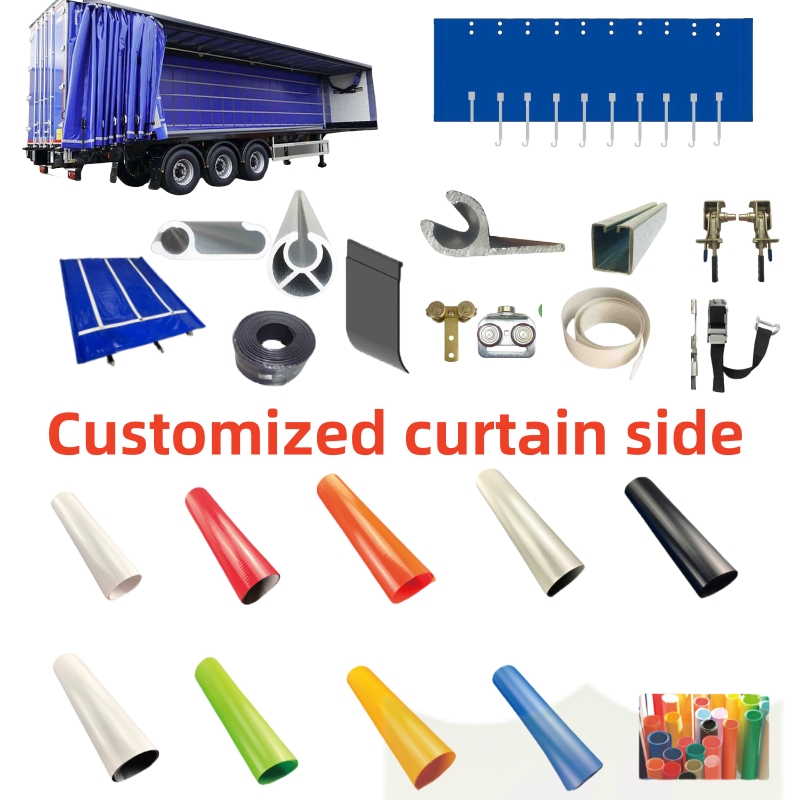
As a manufacturer specializing in truck body parts, Ganland Auto Parts supplies the complete curtain package: PVC tarpaulin (900 gsm standard, custom GSM, custom cut and printed), ball bearing curtain rollers (30 mm, galvanized, double roller), over-center buckles and polyester bottom strap kits, ratchet tensioners (square 12x12), aluminum top/bottom rails and pelmet profiles, sealing gaskets, adaptors and mounting hardware.
All components are available for custom manufacturing to your technical drawings, with 8-year Gold Supplier credentials and exports to 60+ countries. Request a quote at sales3@gl-truck.com or WhatsApp +86 173 6732 1309.
Related Posts